I ii
Wolfgang Korsus Dipl.-Ing. NT, Astrophysiker
Chapter 333/15 Part 2
Humanity began to think, but about whom or what? Or more precisely, when did people first hold „PLASTIC“ in their own hands? Well, I’m not a fan of „guessing,“ so let’s get down to brass tacks (let’s get to the point!)
Here we go! ……with have been used by humans since time immemorial. For example, „wood“ serves as a building material and wool as clothing… In Arabia, water basins and canals were sealed with natural „asphalt.“ Certain tree resins were also used there as „gum arabic“ and even exported to Europe. Amber from Eastern Europe is known as a fossil resin used in arrowheads and jewelry, and in the Middle Ages, animal horn was transformed into a plastically deformable material through certain processes. As early as 1530, the Fugger family used a recipe by the Bavarian Benedictine monk „Wolfgang Seidel“ to make transparent artificial horn… yes, from goat cheese, which they also sold.
This was followed by a well-known name, „celluloid,“ which was used to describe a group of plastic compounds made from cellulose nitrate and camphor. Celluloid is valued because it can be easily melted and molded. Celluloid made it possible for the first time to mass-produce (using die-casting technology) imitations of luxury items made from natural products such as ivory, coral, ebony, horn, tortoiseshell, and mother-of-pearl.
Celluloid is produced by mixing cellulose nitrate with camphor. Camphor serves as a plasticizer for the cellulose nitrate.
A typical celluloid contains about 70 to 80 parts cellulose nitrate, nitrated to 11% nitrogen, 30 parts camphor, 0 to 14 parts dye, 1 to 5 parts ethanol, and other stabilizers and additives that make the plastic more durable and flame-resistant.
History and development
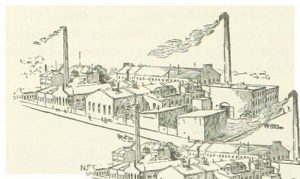
The First industrial production complex of the Celluloid Company in Newark, New Jersey, around 1890
The first celluloid was produced around 1856 by Alexander Parkes, who was unable to commercialize his invention, Parkesine. The name celluloid originated from the trademark „Celluloïd“ registered in 1870 by the Celluloid Manufacturing Company, which produced celluloid protected by John Wesley Hyatt’s patents. Hyatt had been looking for an inexpensive substitute for ivory in billiard balls and had developed a process in which heat and pressure simplified production. In 1878, he bought the patent for Parkesine from Parkes.
In Germany, a production facility for celluloid was established in 1887 with the Deutsche Zelluloid Fabrik in Eilenburg. Before World War I, annual production output was around 12,700 tons of celluloid.
Celluloid film
In the late 1880s, celluloid was developed as a transparent carrier for photographic film. Both Hannibal Goodwin (1887) and the Eastman Company (1889) obtained patents for a Goodwin and the investors to whom he later sold his patents won a patent infringement lawsuit against the Eastman Kodak Company in 1898.
On January 1, 1951, film manufacturers worldwide officially discontinued the production of celluloid raw film. However, it took until the mid-1950s for stocks to be sold out, and it was only when the material was banned as a highly flammable hazardous substance in more and more countries that it disappeared from movie theaters.
Use of injection-molded parts
As early as 1869, Daniel Spill, a partner of Alexander Parkes, described the plastic Xylonite (a further development of Parkesine) as suitable for use in the manufacture of „gears and friction wheels“ as well as „bearings for machinery“ (sliding bearing manufacturers).
As thermoplastics, celluloid found widespread use in the 19th and first half of the 20th century. Among other things, this material was used to make combs, knife handles, ballpoint pen casings, eyeglass frames, and toys. [7]However, it was highly flammable and weathered easily, which is why it was replaced by cellulose acetate plastics and, since 1950, increasingly by PET.
Celluloid is still used as a shaft material for very high-quality pencils and fountain pens, as the haptic properties of celluloid have not yet been achieved with other plastics.
In the musical instrument industry, celluloid still plays a role today as a material for picks, bindings for musical instruments, and foils in drum construction.
Film material
The development of celluloid film laid the foundation for photographic film as we know it today in the form of widely used roll film and 35 mm film, which now competed with photographic plates and ultimately led to the development of motion picture film. In dry environments, the water content of celluloid film gradually decreases. Over time, the material takes on explosive properties and can ignite spontaneously. For this reason, nitrocellulose films, for example in the Federal Film Archive, may only be stored under special safety precautions.
iTable tennis ball

Table tennis balls made of celluloid (diameter traditionally made of celluloid. In order to find a material that is not classified as hazardous and whose raw materials are permanently available in sufficient quantities worldwide, ball manufacturers agreed with the ITTF in 2014 on the so-called plastic ball. This was the result of several years of research and development.
While plastic balls were quickly adopted exclusively in competitions at the federal level, celluloid balls continued to be used at the regional level for a long time due to their greater durability.
Long-term detonators
A celluloid ring here chemically-mechanical long-term detonators colloquially known as „acid detonators“ (although they do not actually contain acid), which were used extensively during World War II, the firing pin spring. When the bomb was dropped, a spindle was screwed into the fuse by a previously unlocked wind wheel, which destroyed a glass ampoule containing acetone. The acetone then dissolved the celluloid and the trigger balls were pressed into the soft celluloid by the spring force, removing the firing pin spring lock. The detonation delay for long-term fuses could be varied between 2 and 144 hours by using different acetone concentrations and different numbers of layers of celluloid rings. Many of the unexploded bombs that are still dangerous today are equipped with such fuses, which for various reasons did not trigger the detonation even after the desired time delay.
Smoke bomb
When celluloid is reacted at low temperatures without an open flame, it produces thick smoke similar to that of military smoke grenades. There are numerous instructions for making these bombs circulating on the internet, most of which are based on crushed table tennis balls.
Plastics in detail:
PVC
Polyvinyl chloride, or PVC for short, is found in large quantities in industrial and consumer goods. It is used in the manufacture of paint, wallpaper, window frames, floor coverings, records, combs, and buttons. It was German chemist Fritz Klatte who combined hydrochloric acid and mercury compounds with acetylene gas and, lo and behold, obtained sweet-smelling vinyl chloride, which he hastily patented in 1912. Depending on how it is manufactured, PVC can feel hard, supple, or soft. It is very versatile and can be produced quickly in very large quantities.
……we come to KEVIAR
An extremely high-performance plastic, extremely strong, it can even „withstand“ heat of 400 degrees Celsius and cold of minus 190 degrees Celsius. I explain these properties by a very close chaining of the molecules, which build extremely strong barriers. Kevlar is used in various areas, for example, and is excellent for protection, such as in bulletproof vests, in sports, such as for hockey sticks or yacht sails, or even for drum kits. You can imagine that this is why research into other high-performance plastics like Kevlar is still being conducted eagerly today.
The next interesting one is „Styrofoam.“
When some plastics are treated with „gas,“ their properties change dramatically. Polystyrene, for example, transforms from a „compact“ mass into a „light“ and „porous“ one, into a well-known foam. For this reason, IG Farben registered a patent for this material in 1930. Incidentally, it remains dense and hard, as we know from clothes hangers or clothes pegs! However, when gas and hydrogen are added, it expands and becomes pleasantly soft and light. You know it as „snow white,“ which is how „Styrofoam“ is used as packaging for very sensitive goods or even entire buildings.
…continue to PET
This abbreviation stands for polyethylene terephthalate. It is mainly used by consumers as a „liquid container.“ The start of this material is well known: it began in 1978 with Coca-Cola and a „2-liter bottle.“ As we know, today one-third of all beverages worldwide are filled in PET bottles. It is thought-provoking and „controversial“ whether they release substances that cause damage to humans.
My research revealed different studies with various results, which I do not want to explain here! However, the advantage of soft plastic containers is their well-known „lightness,“ as they weigh just 12 to 112 grams. PET belongs to the polyester family, whose fibers are also known as Trevira and diols.
I say „Teflon“
That can also be the case…⇒ ⇒ ⇒
The American chemical company Dupont naturally also has researchers, to whom the following happened:
They researched long and hard, but for a long time failed to recognize the usefulness of a substance they had invented in 1938. Five whole years passed, and it was not until 1943 that something was needed that was as resistant as possible to strong acids.
Hurray!!! „……Polytetrafluoroethylene“ came into use and has been used „ever since“ to coat pipes and containers. It gets even better: in 1954, the first frying pan was coated with it, and since then Teflon has been found in many households. Teflon has even gained significance in youth slang; I inquired about it, and it refers to something or someone that everything „slides off“ of.
Nylon… that always makes me think of slim, sexy women’s legs!
Because there was a day when a crowd of women rushed into a department store in the USA! Why? Because the first nylon stockings were on sale. There were 4 million pairs, and they sold out in no time. This had absolutely nothing to do with a miracle… No wonder… until 1940, transparent stockings had to be made of silk and were therefore considered unaffordable luxury items. The tear-resistant synthetic fiber nylon became synonymous with elegant legwear at that time. But today, many other plastics also fulfill this characteristic. There are similar plastics with „similar“ properties, also for stockings, but nylons, „with or without seams,“ remain firmly on the „market.“
…a few more to follow: Plexiglas
In 1928, Otto Röhm (a chemist) applied for a patent for a new plastic and marketed it as Plexiglas. This immediately reminds me of my childhood; back then, it was an „everywhere material,“ and I also know this material as acrylic glass. I have been told that „it is often used by architects and designers.“ A prominent example is the lid of the Braun SK 4 radio record player from 1956, known as the Snow White coffin. Evonik Röhm GmbH still owns the rights to the registered brand name today. Plexiglas is used in many areas, from watches to medicine.
Selenium
The element silicon makes silicones „resistant“ and „durable.“ In 1940, German chemist Richard Müller was searching for an artificial fog, but instead, as if by magic, he found „a white mass“ that is so significant that „it“ has become one of the most widely used materials in industry. Already or already? In the 1950s, experts counted „hundreds of silicone products“; today, without even trying, there are thousands. Even those just born (babies) definitely find this thing „earth-shatteringly“ good!!! ……………………
………….it’s the pacifier! — The first plastic of their lives!
The salesperson involved in the transaction would casually mention:
Buy… implants, makeup, creams, insulation materials, or car paints!
„From a technical point of view, these are considered particularly ‚tough‘ and ‚waterproof‘ thanks to silicone!
Quietly to the glass Plexiglas!……wrong! I mean…. Plexiglas
In 1928, chemist Otto Röhm applied for a patent for a new plastic and marketed it as Plexiglas. This material is also known as acrylic glass. It is often used by architects and designers. A prominent example is the cover of the Braun SK 4 radio record player from 1956, known as the Snow White coffin. Evonik Röhm GmbH still owns the rights to the registered brand name today. Almost speechless, I would like to add:
Plexiglas is used in many areas, from watches to medicine, which is miles away.
Polyethylene
Chemists Karl Ziegler and Giulio Natta discovered how to link monomers to polymers without high pressure and high temperatures. The two received the Nobel Prize in 1963 for their catalyst process. This enabled the chemical industry to produce large quantities of plastics, the polyethylenes that had already been discovered. Shopping bags, garbage cans, and beverage crates are made from them, far too many for the liking of environmentalists. Ethylene also comes from petroleum, i.e., from „fossil energy.“ ( Please note )
Celluloid
When billiards became fashionable, the balls were still made of ivory. The American John Wesley Hyatt experimented and filed a patent for a thermoplastic material in 1865. At first, playing with his cellulose balls made such a loud bang that cowboys standing at the pool table reached for their Colts. Later, Hyatt used his celluloid to make dentures, jewelry, and toys. The dream factories in Hollywood also appreciated this material, which they used to capture their films from then on.
Plastics finished … Part 3 follows
_p568_NEWARK,_THE_CELLULOID_COMPANY.jpg)


